

200+ New AI Models in a Month: How Should Ordinary People Choose?

Availability checked on November 13, 2026. Rollouts change fast, so confirm on each company’s own page before you pay for anything.
Key takeaways
- You can’t test 200 models, and you don’t need to. The “200+ in a month” figure depends on what you count. Trackers that log only notable launches found 23 to 34 for October 2026, and catalogs that include every variant and fine-tune list many more.
- Choose by the job, not the version number. Everyday writing, coding, photo editing and short video each reward different strengths, and a newer name doesn’t guarantee a better result for your task.
- Run a 30-minute test with your own tasks. Two tools, the same prompt, four scoring questions. Then pick a default and stop checking the news every morning.
It has been a loud ten days for AI. OpenAI shipped Images 2.6 on November 4 and unveiled GPT-6 Cyber a day later. ByteDance released Seedream 5.5 on November 9. Google opened Gemini 4 Carbon to paying users on November 10, and Alibaba put Qwen4-Max into preview on November 11. xAI says Grok 4.8 is about to reach its first group of users.
If you read all of that and felt behind, you are in good company. The honest truth is that most of those names don’t change what an ordinary person should do this week. The useful skill isn’t keeping up with every launch. It’s knowing which launches are even meant for you.

This week’s six names, and who can use them
Here is where each model stands as of November 12, with a stripe and label that show what “available” really means.
OpenAI Images 2.6
Available nowReleased November 4 in ChatGPT and Codex on every plan, across web, desktop and mobile. It generates images about 50% faster than the version before, makes animated GIFs, and lets you save reference images of yourself, pets or characters to reuse. Developers get two API models: Flare for speed and Sunburst for higher quality and consistency across edits.
Worth your time if you already use ChatGPT and make images or edit photos.
Google Gemini 4 Carbon
Paid accessAnnounced October 28 and first given to a small group of security defenders. On November 10 it opened to paying developers, businesses and Google AI Ultra subscribers in the Gemini app, AI Mode in Search and Antigravity. Google AI Pro subscribers get Gemini 4 Argon instead. The introductory API price doubles after November 30.
Worth your time if you’re on Ultra or build with the API. Google’s model picker labels Argon for code and analysis and Carbon for the most complex work, so most people won’t miss it.
ByteDance Seedream 5.5
Live in select toolsReleased November 9. ByteDance highlights native transparent backgrounds, stable editing across up to 100 rounds, and sharper small text and realism. It is live on BytePlus’s Lumina platform, API access is listed as coming soon, and a Pro version is promised later.
Worth your time if you make product shots, cutouts or designs that need many rounds of small edits.
Alibaba Qwen4-Max
Preview until November 25Released November 11 as a preview on Alibaba Cloud’s Token Plan, with early access in the Qwen app, QwenWork, Qoder and QwenStudio. It reads text, images and video and handles up to a million tokens of context. There are no downloadable weights and no date yet for the other Qwen 4 sizes.
Worth your time if you’re a developer who likes testing early. Everyone else can wait for the full release.
xAI Grok 4.8
Limited rolloutOn November 10, Elon Musk said a limited release for Grok Bot users would begin later this week, with reinforcement learning still underway. He also cautioned that the model isn’t yet impressive. In the reports we found, xAI hadn’t published a launch post, API listing or benchmarks, and Grok 4.7 from September 21 was still its latest official model.
Worth your time if you already use Grok Bot. Otherwise, wait for real benchmarks.
OpenAI GPT-6 Cyber
Security teams onlyAnnounced November 5 as a cyber-specialized variant of GPT-6 Astra, built for authorized security work such as finding and fixing vulnerabilities. It’s available to select Daybreak Red customers, with access expanding over time.
Worth your time if you work in security. For everyone else it’s a news story, not a tool.
Why the “200+” number matters less than it sounds
Counting AI models is surprisingly slippery. One tracker verified 23 distinct releases from 17 labs in October 2026. Another logged 24, and a third listed 34. Catalogs that include every fine-tune, quantized version and re-hosted checkpoint show far larger numbers.
That’s why “200+ models in a month” can be true and still not very useful. Most of those releases are small variants, specialist tools, research previews or models aimed at developers. The handful that matter to you depend on what you do all day, which is exactly why it’s better to choose by job.
Pick by the job, not the version number
| Your job | What to judge | A sensible default |
|---|---|---|
| Everyday writing, research, questions | Accuracy on your topics, speed, and what your plan already includes | The assistant in the plan you already pay for. Test a newer one only on tasks it keeps getting wrong. |
| Coding and long tasks | Long context, tool use, and cost per task, not just headline price | Try the newest flagship on one real task, and note when introductory pricing ends. |
| Photo edits and image creation | Likeness across edits, readable text, and whether the second and third edit still match the first | Test Images 2.6, Seedream 5.5 or Nano Banana 2.1 with your own photo and the same prompt. |
| Short video and photo effects | How fast you get a good result on your phone | A purpose-built app with ready-made effects beats assembling your own model stack. |
| Security research | Authorization, scope, and access | Specialist models like GPT-6 Cyber, through the vendor’s approved programs only. |
Three questions before you try anything new
- Can I use it today, in something I already pay for? If the answer is a waitlist, a preview, a security-only program or a higher plan you don’t have, bookmark it and move on.
- What exact problem would it fix? “It’s newer” isn’t a problem. “My edits keep changing my face” or “the text on my poster is garbled” is.
- What happens to the price or access later? Gemini 4 Carbon’s introductory API rate ends after November 30, and the Qwen4-Max preview ends on November 25. A great deal that disappears isn’t a plan.
A 30-minute test you can repeat every month
- Pick three real tasks from this week. Use your own emails, photos or spreadsheets, not demo prompts from a launch page.
- Run the identical prompt in two tools. Your current one and one challenger. Don’t tweak the wording for the newcomer.
- Score each result on four questions. Did it do what I asked? Did it keep what I told it to keep? Could I use it without fixing anything? How long did it take?
- Write down a default. One line in your notes: “For photo edits I use X, for research I use Y.” A written default stops the daily second-guessing.
- Re-test when your problem changes, not when a headline appears. A monthly check is plenty for most people.
A test prompt that exposes the differences
Image models love to show off on the first try. This prompt checks the three things that usually break first: your likeness, small text, and what happens on the second edit.
When the job is photo-first, skip the model hunt
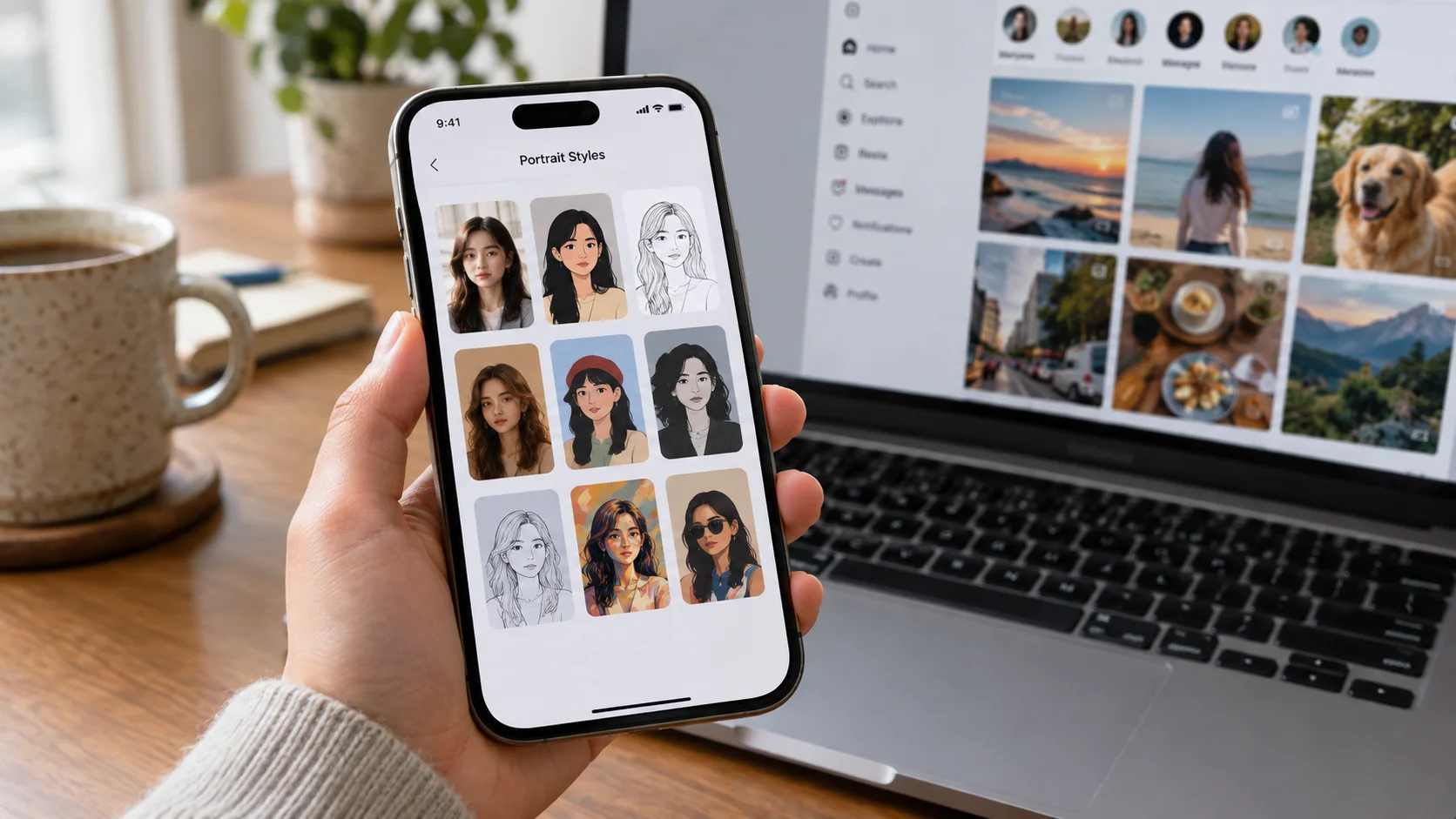
Many everyday AI tasks start with a photo you already have: trying a new outfit, tidying a portrait, redrawing a picture in a new style, or turning a memory into a short clip. For those, picking a model matters less than picking an effect that works in two taps.
Movcl bundles those jobs into a phone app. On the image side you get Art Redraw, Virtual Outfit, Face Swap and One-Click HD. On the video side there are Memories, Spotlight, Movie Roles, Fun and Dream Places. You choose the result you want and skip the version numbers. Keep following the model news for fun, but let your tools handle the rest.
Frequently asked questions
- Do I need to switch AI tools every time a new model launches?
- No. Switch only when a new model fixes a specific problem you actually have, and when you can use it today in a tool you already pay for or can try for free.
- Is Seedream 5.5 better than ChatGPT Images 2.6?
- There is no independent verdict yet. ByteDance’s published evaluation compares Seedream 5.5 with its own Seedream 5.0 Pro, not with OpenAI’s model. Test both with your own photos and the same prompt.
- What is the best AI model right now?
- There isn’t one. The best choice depends on the job, and the model that wins at coding may not be the one that keeps your face consistent across photo edits.
Have a photo and a few minutes? Skip the comparison chart.
Try a new outfit, redraw it in a new style, or turn it into a short AI video, right from your phone.
Try MovclSources
- OpenAI, “Introducing Images 2.6” (November 4, 2026), with coverage from GIGAZINE and Mediasat
- OpenAI, “GPT-6 Cyber” announcement and system card (November 5, 2026), with coverage from The Hacker News
- Google, “Gemini 4 Carbon is now available” (November 10, 2026), with coverage from Technology.org and Digital Trends
- ByteDance Seed, “Introducing Seedream 5.5” (November 9, 2026), and BytePlus Lumina release notes
- Alibaba Cloud and Qwen announcements of the Qwen4-Max preview (November 11, 2026), with coverage from Yotta Labs and Cellcog
- Reports on Elon Musk’s November 10, 2026 Grok 4.8 rollout comments (TokenPost, ExplainX)