
Can You Get in Trouble for Making AI Images? Common Scenarios Explained
"Is this legal" isn't one question. It's a different question for every scenario.
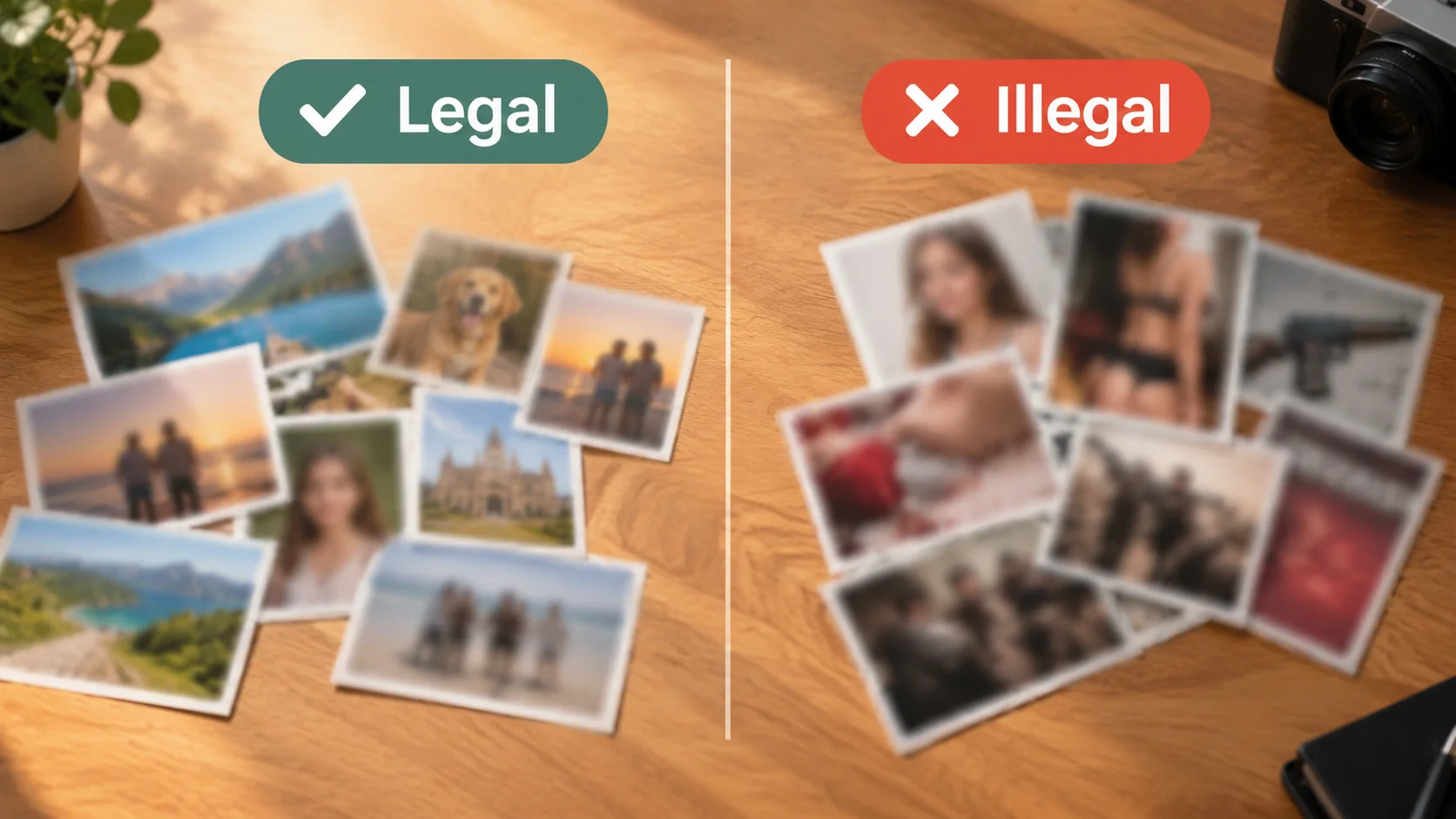
Key takeaways
- Legal risk with AI-generated images isn't one bucket — it ranges from essentially no risk (your own photo, personal use) to serious legal exposure (non-consensual intimate content, fraud, impersonation intended to deceive), and treating every scenario the same way leads to either unnecessary anxiety or genuine blind spots.
- The lowest-risk category is using your own photo for personal, obviously synthetic, non-commercial content — nothing about that is illegal in the US.
- Using someone else's photo without asking sits in a meaningfully riskier middle zone, where the outcome depends heavily on what you create and what you do with it afterward.
- Non-consensual intimate imagery and impersonation intended to deceive for financial gain or to damage someone's reputation are the two categories with the clearest, most established legal consequences — the first through rapidly expanding state and federal law, the second through long-standing fraud and defamation law that simply now applies to AI-generated content too.
"Can I get in trouble for this?" is a genuinely different question depending on what "this" actually is, and lumping every AI image scenario into one worry — or one shrug — misses that entirely. Making a stylized portrait of your own face is not the same legal category as generating content using someone else's likeness without asking, and neither of those is the same category as using AI to fabricate fraudulent documentation. Here's how those scenarios actually differ.
Your own photo, personal use
Low riskUsing your own selfie to generate an anime-style portrait, a period-drama character, or a fantasy scene for your own social feed isn't illegal in the US, and it's the scenario the vast majority of AI photo app usage actually falls into. We covered the two narrower questions that do apply here — who owns the copyright to the result, and whether you can use it for something official like a passport — in an earlier piece on AI image legality. Neither of those affects your basic right to generate and share content using your own likeness. Template-based personal use — the kind of thing apps including Movcl are built around — sits squarely in this low-risk category.
Someone else's photo, without asking
Medium risk — depends heavily on specificsThis is where things get genuinely context-dependent. Using a photo of a friend, a coworker, an ex, or a stranger without their knowledge sits in a middle zone where the outcome depends almost entirely on what you make and what happens to it afterward. A harmless, obviously joking edit shared privately with the person's knowledge is a very different situation from an embarrassing, sexualized, or reputation-damaging image shared publicly without consent. The latter can trigger harassment claims, and depending on your state, right-of-publicity claims — the state-by-state patchwork we covered in the same earlier piece on AI image legality. As a baseline: if you wouldn't be comfortable explaining to that person exactly what you made and why, that's a reasonable signal you're already in riskier territory, independent of the exact legal outcome.
Non-consensual intimate content
High risk — the clearest legal consequencesWe named this category in our piece distinguishing deepfakes from face swap apps, and it's worth repeating here specifically: generating sexual or intimate content depicting a real, identifiable person without their consent is the single fastest-expanding category of AI-specific legislation in the US, at both the state and federal level. This is also the category where enforcement and platform detection have both been ramping up quickest, since it's the harm that drove much of the recent legislative attention to AI-generated media in the first place.
Impersonation meant to deceive
High risk — long-standing law, not AI-specificUsing an AI-generated image or video to impersonate a real person in a way intended to deceive — faking a statement to damage someone's reputation, fabricating "evidence" for a dispute, impersonating someone to extract money or information — isn't waiting on new AI-specific legislation at all. It falls under existing, well-established legal categories: fraud, defamation, and identity-theft-adjacent statutes that don't care what tool was used to create the deceptive content. The technology is new; the legal exposure for using it this way generally isn't.
Commercial use featuring someone else's likeness or a copyrighted character
Medium-to-high risk — depends on use and jurisdictionSelling merchandise, advertising, or any commercial product featuring an AI-generated image of a real person's likeness without their permission runs directly into right-of-publicity law, generally with sharper teeth for commercial use than for personal or editorial use. Similarly, generating AI images that recreate a specific copyrighted character or trademarked brand and using them commercially can raise separate copyright and trademark issues, independent of anything specific to AI — the same rules that would apply to drawing that character by hand and selling it.
| Scenario | Risk level | Why |
|---|---|---|
| Your own photo, personal use, shared casually | Low | No law against using your own likeness for personal, non-official content |
| Someone else's photo, harmless edit, shared with their knowledge | Low-to-medium | Context and consent matter more than the technology itself |
| Someone else's photo, embarrassing or shared without consent | Medium-to-high | Possible harassment or right-of-publicity exposure, depending on state |
| Non-consensual intimate content of a real person | High | Rapidly expanding, increasingly specific state and federal law |
| Impersonation intended to deceive, defraud, or defame | High | Established fraud and defamation law, independent of AI |
| Commercial use of a real person's likeness without permission | Medium-to-high | Right-of-publicity law, generally stricter for commercial use |
A quick self-check before you post
Four questions cover most of the real-world cases:
- Whose likeness is it? Your own is close to always fine. Someone else's requires more thought, and someone else's without their knowledge requires the most.
- Did they consent, or would they be comfortable if they saw it? This is a good proxy even before getting into specific state law.
- What's the content actually depicting? Obviously fictional and non-sexual is very different from realistic, embarrassing, or intimate.
- What are you doing with it? Keeping it private, sharing it casually, posting it publicly, and using it commercially are four different risk levels, in roughly that order.
Platform rules aren't the same as the law
Worth separating clearly: an app or platform suspending your account for violating its own content policy is a completely different system from breaking an actual law. A platform can prohibit things that aren't illegal (many do, deliberately, to stay ahead of misuse), and conversely, something illegal doesn't automatically get caught or acted on by a platform's moderation. Getting flagged by an app isn't proof you did something illegal, and not getting flagged isn't proof you didn't.
A quick glossary
- Defamation
- Making a false statement of fact about someone that damages their reputation — a long-standing legal category that applies to AI-generated content the same way it applies to any other false statement.
- Right of publicity
- A state-level legal concept protecting a person's ability to control certain uses of their own identifiable likeness, generally with stronger protection for commercial use.
- Non-consensual intimate imagery (NCII)
- Sexual or intimate content depicting a real person without their consent, including AI-generated versions — currently the fastest-expanding area of AI-specific legislation in the US.
Frequently asked questions
Is it illegal to make an AI image of a celebrity?
It depends on the context. Obviously fictional, non-commercial parody or commentary generally has more legal protection than content designed to look authentic or to be sold commercially using a celebrity's likeness without permission. This varies by state and by exactly how the image is used.
Can I get in trouble for using an AI app on a photo of a friend without asking them first?
It depends heavily on what you create and do with it, but at minimum it's worth asking first as a matter of basic respect. If the result is embarrassing, sexual, or shared publicly without their consent, the legal exposure increases significantly and can include harassment or right-of-publicity claims depending on your state.
Is using AI to impersonate someone always illegal?
Not automatically, but impersonation that's intended to deceive someone for financial gain, to damage a reputation, or to create fraudulent documentation crosses into fraud, defamation, or identity-theft-adjacent territory, which are well-established legal categories independent of the technology used to create the image.
Does getting my AI image account suspended mean I broke the law?
No — those are separate systems. A platform can suspend your account for violating its own terms of service even if nothing you did was illegal, and conversely, breaking a law doesn't automatically mean a platform will catch or act on it.