
AI image API prices, compared: October 2026
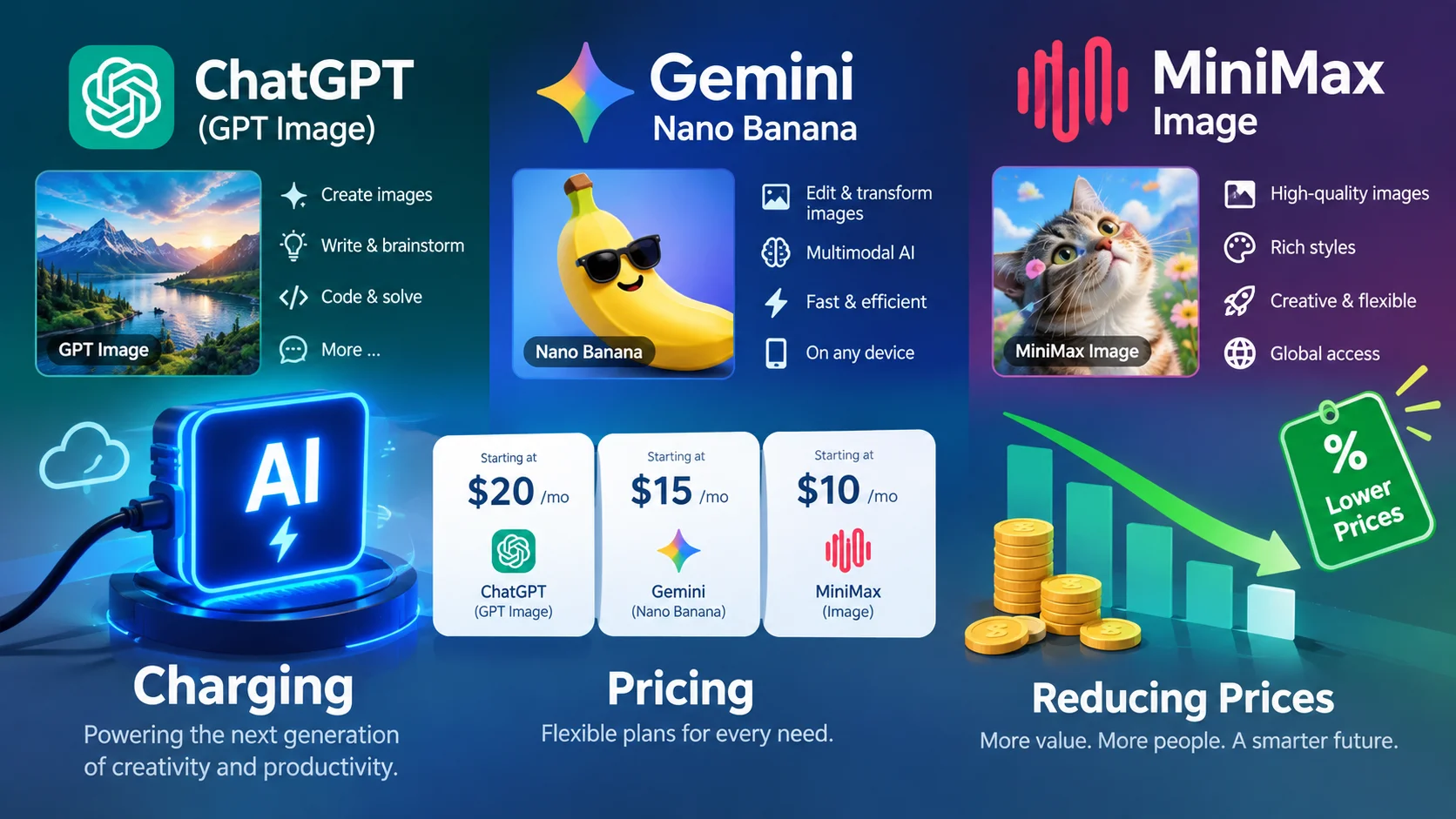
Google just cut Nano Banana's price in half. Here's what every major image model actually costs per picture, where the "cheap" prices hide extra charges, and what a product catalog runs you at real volume.
The short version
- Cheapest commercial API
- MiniMax image-01 at $0.0035 per image (international list price).
- Best quality per dollar
- Meta Muse Image: a flat $0.01 per image at any resolution, ranked #8 on the Artificial Analysis leaderboard.
- Best value near the top
- Nano Banana 2.1: $0.0336 per 1K image ($0.0168 via Batch), ranked #4.
- Highest quality
- GPT Image 2.5 at max quality, around $0.21 per 1024² image. OpenAI hasn't published that number; it's a third-party estimate.
- Free API
- Neither Google nor OpenAI offers one. Pollinations.AI works without a key, and a few vendors give trial images.
What's in this guide
- Nano Banana 2.1: the price cut and the fine print
- The full price table
- Why "per image" comparisons mislead
- OpenAI: cheaper tokens, pricier images
- Quality per dollar
- Official prices vs. resellers
- Models that are gone or going
- For e-commerce sellers: what a catalog costs
- For developers: ten ways to spend less
- Is self-hosting cheaper?
- Free options that actually exist
- FAQ
On October 6, Google released Nano Banana 2.1 and priced a standard 1K image at $0.0336. Nano Banana 2 costs $0.067 for the same image, so that's a straight 50% cut on the size most apps generate. It's the biggest price move in image APIs this year, and it landed in an already busy stretch: FLUX 3 launched October 1, OpenAI shipped GPT Image 2.5 on September 8 without a per-image price, and several models that still top "cheapest image API" roundups have been switched off.
So I rebuilt the comparison from the official pricing pages. This guide covers 30+ models from 20 vendors, a dozen resale platforms, and the parts of the bill that don't show up in the headline number. Where a price only exists in third-party reporting, I've marked it. Movcl doesn't sell API access and doesn't earn referral fees from any platform below, so there's no reseller to push here.
Nano Banana 2.1: half price, with fine print
Nano Banana 2.1 (model ID gemini-nano-banana-2.1) went straight to general availability on October 6. It's built on Gemini 3.6 Flash, and it's now the model Google points everyone to when they migrate off Imagen 4, Nano Banana 2, or Nano Banana Pro.
The quality story is strong. Nano Banana 2.1 debuted at #4 on the Artificial Analysis text-to-image leaderboard (Elo 1160), behind only three OpenAI configurations that each cost about six times more per image. Here's how it compares with the rest of the family on Google's own price list:
| Model | Input / 1M tokens | Image output / 1M | 1K | 2K | 4K | Batch 1K |
|---|---|---|---|---|---|---|
| Nano Banana 2.1 | $1.50 | $30 | $0.0336 | $0.0504 | $0.113 | $0.0168 |
| Nano Banana 2 | $0.50 | $60 | $0.067 | $0.101 | $0.151 | $0.034 |
| Nano Banana 2 Lite | $0.25 | $30 | $0.0336 | 1K only | 1K only | $0.0168 |
| Nano Banana Pro | $2.00 | $120 | $0.134 | $0.134 | $0.24 | $0.067 |
Three details change the math depending on how you use it.
- Input got 3x more expensive. Input tokens went from $0.50 to $1.50 per million. Plain text-to-image barely notices this. But if your workflow is editing (a product photo plus two or three style references for every output), you'll save noticeably less than half.
- The cut shrinks at higher resolutions. 1K and 2K drop by 50%, but 4K only goes from $0.151 to $0.113, about 25%. Some launch-day coverage quoted $0.0756 for 4K; Google's page says $0.113, and that's the number to budget with.
- Nano Banana 2 Lite already had this price. At 1K, 2.1 and 2 Lite cost exactly the same. The difference is that 2.1 ranks 65 Elo points higher and also does 2K and 4K. If you're on Lite, switching costs nothing at 1K.
Google hasn't announced a shutdown date for Nano Banana 2 (a few third-party sites say October 29, which I couldn't confirm). Either way, at half the price and a higher ranking, there's little reason to stay on it. For a full feature walkthrough, see our complete guide to Gemini Nano Banana.
Google doesn't cut prices on existing models. Every price drop since Imagen 4 has come from a new model replacing an old one.
The full price table
Every model below is priced for one image at about 1 megapixel (the "1K" setting), at standard pay-as-you-go rates, before tax and without batch discounts. Dollar prices come from each vendor's international pricing page. I didn't convert any yuan prices myself. The bars use a log scale, because the cheapest and most expensive models here are 60x apart.
| Model | Vendor | Per image | Relative cost (log scale) | Worth knowing |
|---|---|---|---|---|
| Budget: under $0.02 | ||||
| MiniMax image-01 | MiniMax | $0.0035 | Lowest list price of any commercial API | |
| Recraft V4.1 Flash | Recraft | $0.007 | Released September 2026 | |
| Muse Image | Meta | $0.01 | Flat price at any resolution; #8 on Artificial Analysis | |
| CogView-4 | Zhipu (Z.ai) | $0.01 | ||
| GPT Image 2.5 (medium) | OpenAI | ~$0.013 | third-party estimate OpenAI publishes token prices only | |
| FLUX.2 [klein] 4B | Black Forest Labs | $0.014 | Starting price; weights are Apache 2.0 | |
| K2 Turbo | Krea | $0.015 | ||
| GLM-Image | Zhipu (Z.ai) | $0.015 | Open-sourced under MIT | |
| Seedream 5.0 Flash | ByteDance (BytePlus) | $0.018 | Released September 24, 2026 | |
| Mainstream: $0.02 to $0.08 | ||||
| gen4_image_turbo | Runway | $0.02 | ||
| FLUX.2 [pro] | Black Forest Labs | $0.03 | Per-megapixel pricing; editing starts at $0.045 | |
| Qwen-Image 3.0 | Alibaba Cloud | $0.03 | Singapore region price | |
| Ideogram 4.5 (low) | Ideogram | $0.03 | third-party reported Medium tier $0.06 | |
| Nano Banana 2.1 | $0.0336 | New October 6; #4 on Artificial Analysis | ||
| Nano Banana 2 Lite | $0.0336 | 1K only | ||
| Seedream 5.0 Lite | ByteDance (BytePlus) | $0.035 | ||
| Recraft V4.1 | Recraft | $0.035 | $0.08 for vector (SVG) output | |
| MAI-Image-2.6 | Microsoft | ~$0.039 | derived from leaderboard Token-billed on Azure | |
| grok-imagine-image-2.0 | xAI | $0.04 | Some resellers list $0.04–$0.08 by tier; blocked images are billed | |
| Qwen-Image 3.0 Pro | Alibaba Cloud | $0.04 | $0.075 at 2K | |
| Uni-1.1 | Luma | $0.0404 | Priced at 2K | |
| Seedream 5.0 Pro | ByteDance (BytePlus) | $0.045 | Doubles to $0.09 above 2.61 MP | |
| FLUX 3 Image | Black Forest Labs | $0.048 | New October 1; launch discount has ended | |
| GPT Image 2 (medium) | OpenAI | $0.053 | Official per-image table | |
| Nano Banana 2 | $0.067 | Replaced by 2.1 at half the price | ||
| Stable Image Ultra | Stability AI | $0.08 | third-party reported Stable Image Core is $0.03 | |
| Premium: above $0.10 | ||||
| Nano Banana Pro | $0.134 | $0.24 at 4K; now ranks below 2.1 | ||
| GPT Image 2 (high) | OpenAI | $0.211 | #3 on Artificial Analysis | |
| GPT Image 2.5 (max) | OpenAI | ~$0.211 | third-party estimate #1 on both major leaderboards | |
| Ideogram 4.5 (high) | Ideogram | $0.22 | third-party reported | |
A few patterns stand out. The mainstream band is crowded: more than a dozen capable models sit between $0.03 and $0.05, so price alone won't decide between them. The models from Chinese vendors (MiniMax, Zhipu, ByteDance, Alibaba) are consistently cheaper at the flagship level, at about $0.03–$0.09 per image versus $0.134 for Nano Banana Pro. And Recraft is still the only mainstream API that outputs true vector files, which matters if you need logos or icons rather than pictures.
If you're a US business, the cheapest row isn't automatically the right one. Check where a vendor processes and stores your images, and what its terms say about using your inputs, before you send it customer photos or unreleased product shots.
Why "per image" comparisons mislead
The table above is as fair as I can make it, but every vendor counts differently. There are four billing models in use right now:
| Billing unit | Who uses it | What actually moves your bill |
|---|---|---|
| Flat per image | Meta Muse Image, Seedream, Ideogram, MiniMax, Qwen-Image | Resolution tier (for most), number of reference images |
| Per megapixel | FLUX.2 family, FLUX 3 | Exact output size; editing costs more than generating |
| Per token | OpenAI GPT Image, Google Nano Banana, Microsoft MAI-Image | Quality tier, size, input images, retries |
| Credits | Black Forest Labs, Stability, Runway, Recraft (each credit worth $0.01 or $0.001) | Model and options; easy to lose track of in dollars |
Resolution labels are even less consistent. "1K" doesn't always mean 1024 pixels on a side:
- Nano Banana 2's "4K" output measures about 17.15 megapixels. At $0.151, that works out to under a cent per megapixel, which makes it one of the cheapest options per pixel on this list, even though it looks expensive per image.
- Seedream's "1K" setting produces close to twice as many pixels as Nano Banana 2's 1K.
- Seedream 5.0 Pro charges double once you pass 2.61 megapixels, and OpenRouter defaults Seedream to 2048×2048. Forget to set the size and you'll pay $0.09 instead of $0.045.
If resolution matters to you (print, zoomable product images, large banners), divide by megapixels before you compare.
OpenAI: cheaper tokens, pricier images
OpenAI's image output price has fallen three times: $40 per million tokens for gpt-image-1, $32 for 1.5, and $30 for GPT Image 2 and 2.5. That's a 25% cut on paper. But starting with GPT Image 2, each image uses more tokens, so medium and high quality actually cost more per image than they did on 1.5.
| Released | Model | Image output / 1M | Low | Medium | High |
|---|---|---|---|---|---|
| Apr 2025 | gpt-image-1 | $40 | $0.011 | $0.042 | $0.167 |
| Oct 2025 | gpt-image-1-mini | $8 | $0.005 | $0.011 | $0.036 |
| Dec 2025 | gpt-image-1.5 | $32 | $0.009 | $0.034 | $0.133 |
| Apr 2026 | GPT Image 2 | $30 | $0.006 | $0.053 | $0.211 |
| Sep 2026 | GPT Image 2.5 (Flare / Sunburst) | $30 | No official per-image price | ||
GPT Image 2.5 comes in two flavors, Flare (fastest, built for everyday generation) and Sunburst (positioned for precise editing), and both carry identical token prices. What you pay depends on how many tokens each image uses and how often you need to retry. 2.5 also adds two new quality tiers, xhigh and max, and OpenAI's own cost calculator explicitly declines to estimate it.
Several resellers have published their own per-image estimates for 2.5:
| Quality | Tokens (1024²) | 1024×1024 | 1536×1024 |
|---|---|---|---|
| low | 196 | $0.0059 | $0.0047 |
| medium | 439 | $0.0132 | $0.0103 |
| high | 1,756 | $0.0527 | $0.0412 |
| xhigh | 3,122 | $0.0937 | $0.0738 |
| max | 7,024 | $0.2107 | $0.1646 |
Be careful with these numbers. The 2.5 low, high, and max estimates land almost exactly on GPT Image 2's low, medium, and high prices, which suggests some sources may have mapped one onto the other rather than measuring. Other resellers quote anywhere from $0.004 to $0.60 per image for 2.5. Until OpenAI publishes a table, the reliable method is to log the usage field on your own requests.
Three more OpenAI billing details are easy to miss:
- Quality tier is the biggest cost lever. On GPT Image 2, high quality costs about 35x what low does at the same size. OpenRouter's tests also found high took 123 seconds per image versus 12 for low.
- Cached input pricing only works through the Responses API. Image input drops from $8 to $2 per million when cached, but direct calls to the Images API (such as
/v1/images/edits) don't get it. - Streaming previews cost extra. Each partial preview image adds 100 output tokens, about $0.003.
For how the ChatGPT side of this works for everyday users, see our ChatGPT image generation guide.
Quality per dollar
Price only means something next to quality. The table below takes the top of the Artificial Analysis text-to-image leaderboard (blind human preference votes, scored as Elo) and divides each model's score by its cost per 1,000 images. It's a crude ratio, since Elo isn't linear and a 50-point gap at the top is a real difference, but it shows where the bargains are.
| Rank | Model | Elo | Cost / 1,000 images | Elo per $ |
|---|---|---|---|---|
| 1 | GPT Image 2.5 Sunburst (max) | 1198 | $210.70 | 5.7 |
| 3 | GPT Image 2 (high) | 1172 | $211.00 | 5.6 |
| 4 | Nano Banana 2.1 | 1160 | $33.60 | 34.5 |
| 5 | Grok Imagine Image 2.0 | 1156 | $60.00 | 19.3 |
| 6 | MAI-Image-2.6 | 1151 | $38.90 | 29.6 |
| 7 | Nano Banana 2 | 1126 | $67.00 | 16.8 |
| 8 | Meta Muse Image | 1115 | $10.00 | 111.5 |
| 10 | MAI-Image-2.6-Flash | 1105 | $19.50 | 56.7 |
| 12 | Nano Banana Pro | 1102 | $134.00 | 8.2 |
| 15 | Qwen-Image-3.0-Pro | 1088 | $40.00 | 27.2 |
| 16 | Seedream 5.0 Pro | 1081 | $90.00 | 12.0 |
| 17 | Qwen-Image-3.0 | 1075 | $30.00 | 35.8 |
Muse Image delivers roughly 20 times the leaderboard score per dollar of GPT Image 2.5 at max. Nano Banana 2.1 is the standout among models near the very top: it scores within 40 Elo points of first place at one-sixth of the price.
The other major leaderboard, LMArena, broadly agrees: GPT Image 2.5 Sunburst and Flare hold the top two spots, with Nano Banana 2.1 at #6 on early votes. One caveat when comparing the two boards: LMArena tested GPT Image 2 at medium quality (about $0.053 per image), while Artificial Analysis tested it at high ($0.211). Same model, four times the price, so always check which tier a ranking used.
Official prices vs. resellers
Most developers don't call vendors directly. They go through an aggregator like OpenRouter, fal, Replicate, or Together, which gives you one API key for dozens of models. The convenience isn't always free, and occasionally it's cheaper than going direct:
| Model (1K) | Official | Cheapest platform we found | Most expensive platform we found |
|---|---|---|---|
| Nano Banana 2.1 | $0.0336 | kie.ai $0.02 | Most platforms pass through the token price |
| Nano Banana 2 | $0.067 | Together AI $0.05 | fal.ai, Segmind $0.08 |
| Nano Banana Pro | $0.134 | OpenRouter, Together AI $0.134 | fal.ai $0.15 |
| GPT Image 2 (medium) | $0.053 | Together AI $0.053 | Segmind ~$0.06 |
| FLUX.2 [pro] | $0.03 | DeepInfra $0.015 | Matches official elsewhere |
| FLUX 3 Image (768px) | $0.041 | Runware, OpenRouter $0.0205 (launch pricing) | |
| Seedream 5.0 Pro | $0.045 | WaveSpeed $0.045 | Segmind $0.056; OpenRouter $0.09 at default 2048² |
| Qwen-Image | $0.035 | Novita $0.02 |
What the pattern says:
- OpenRouter and Together AI track official prices closely. OpenRouter's own billing test in September recorded GPT Image 2 low at $0.0060 and Nano Banana Pro at $0.1344, matching Google and OpenAI to the fraction of a cent.
- fal.ai and Segmind usually mark up closed models. Expect 12–25% over official prices for Google and OpenAI models, plus add-ons. On fal, Nano Banana 2 with search grounding adds $0.015 per image.
- Discounts are real but often temporary. FLUX 3's half-price launch offer reportedly ended on October 8, and resale platforms tend to follow within weeks. Don't build a budget on a launch price.
- Check the baseline a reseller compares itself to. One reseller advertises Nano Banana 2.1 at "72–75% off official," but the "official" price it lists is actually fal's markup on Nano Banana 2. Against Google's real 2.1 price, the saving is closer to 40%.
Some widely shared numbers are simply wrong. A June article claimed Nano Banana 2 costs about $0.0039 on OpenRouter, roughly a tenth of the measured price, likely because it counted input tokens only. If a price looks too good, check whether it covers output.
A cheaper reseller is also one more company handling your images. Read its data-retention terms, and test that it actually routes to the model version it names.
Models that are gone or going
A surprising number of "cheapest API" articles still recommend Imagen 4 at $0.02. It no longer exists. If your code or your vendor shortlist is more than a few months old, check it against this list:
| Model | Status | Move to |
|---|---|---|
| DALL·E 2 and DALL·E 3 | Shut down May 12, 2026 | GPT Image 2.5 |
| Amazon Titan Image G1 v2 | End of life June 30, 2026 | No AWS-built successor yet |
| Reve (official API) | Shut down August 14, 2026 | Reve 2.1 is only available through third parties |
| Imagen 4 Fast, Standard, Ultra | Shut down on the Gemini API August 17, 2026 | Nano Banana 2.1 |
| Amazon Nova Canvas | End of life September 30, 2026 | A third-party model on Bedrock |
| Nano Banana (gemini-2.5-flash-image) | Google's pages list two dates: October 2, 2026 or March 15, 2027 | Nano Banana 2 Lite or 2.1 |
| gpt-image-1 | Shuts down October 23, 2026 | GPT Image 2.5 Flare |
| gpt-image-1.5, gpt-image-1-mini, chatgpt-image-latest | Shut down December 1, 2026 | GPT Image 2.5 Flare or Sunburst |
The one that needs attention this month is gpt-image-1, with two weeks left. Budget for the migration too: moving from gpt-image-1-mini (about $0.011 at medium) to any current OpenAI model will raise the per-image cost.
For e-commerce sellers: what a catalog actually costs
If you sell online, you probably care less about tokens and more about one question: what does it cost to produce the images for my listings every month? Here's a concrete scenario. Say you generate 2,000 images a month, a mix of white-background product shots, lifestyle scenes, and ad variations, at around 1K resolution.
| Model | Per image | 2,000 / month | 20,000 / month |
|---|---|---|---|
| Meta Muse Image | $0.01 | $20 | $200 |
| Nano Banana 2.1 (Batch) | $0.0168 | $34 | $336 |
| Nano Banana 2.1 | $0.0336 | $67 | $672 |
| Seedream 5.0 Pro | $0.045 | $90 | $900 |
| FLUX 3 Image | $0.048 | $96 | $960 |
| GPT Image 2 (medium) | $0.053 | $106 | $1,060 |
| Nano Banana Pro | $0.134 | $268 | $2,680 |
| GPT Image 2 (high) | $0.211 | $422 | $4,220 |
Even at the premium end, generation is cheap next to a product photoshoot. The real cost driver is the share of images you throw away. A $0.01 model that needs three attempts to get a usable product shot costs $0.03 per keeper, which is more than a $0.025 model that nails it first time. Track cost per usable image, not cost per generation.
Other hidden costs that show up on seller bills:
- Editing costs more than generating. FLUX.2 [pro] charges $0.03 to generate and from $0.045 to edit. Seedream charges an extra $0.003 for each reference image after the first.
- Some vendors bill for refused images. xAI charges for images blocked by its content policy. Meta, ByteDance, Black Forest Labs, and Krea don't charge for failed or filtered outputs.
- Watch the resolution ceiling. Push Seedream 5.0 Pro past 2.61 MP for a zoomable gallery image and the price doubles.
Match the model to the shot
| Job | What matters most | Reasonable starting points |
|---|---|---|
| High-volume background swaps and simple product shots | Low price, consistent output | Meta Muse Image, Nano Banana 2.1 via Batch, Seedream 5.0 Flash |
| Lifestyle scenes built from your real product photo | Faithful editing, support for multiple references | Nano Banana 2.1, FLUX 3 Image (up to 10 references), GPT Image 2.5 Sunburst |
| Ad creatives with headlines or packaging text | Clean text rendering | GPT Image 2.5, Ideogram 4.5 |
| Logos, icons, store badges | Vector output you can scale | Recraft V4.1 vector ($0.08) |
| Large hero banners and print | Price per megapixel | Nano Banana 2.1 at 4K ($0.113, or $0.0567 via Batch) |
Whatever you generate, the listing still has to represent the product accurately. AI is great for backgrounds, scenes, and variations, but don't let it alter the product itself. Check your marketplace's current rules on AI-generated imagery before you upload.
For developers: ten ways to spend less
| Tactic | Typical effect | The catch |
|---|---|---|
| Use the Batch API | 50% off at both OpenAI and Google | Results can take up to 24 hours |
| Drop the quality tier | GPT Image 2 low is ~35x cheaper than high | Test whether users can tell the difference |
| Pick sizes deliberately | GPT Image 2 high at 1536×1024 is 22% cheaper than at 1024² | Aspect ratio must suit the layout |
| Set the size explicitly on aggregators | Avoids defaults like Seedream at 2048² ($0.09) | Easy to forget in SDK wrappers |
| Cache repeated inputs | OpenAI image input drops from $8 to $2 per million | Responses API only |
| Route by stage | Draft with a $0.005–$0.014 model, finish with a premium one | Two models can look different; keep prompts portable |
| Turn off paid extras | Search grounding on fal adds $0.015 per image | Some prompts need fresh references |
| Avoid streaming previews in batch jobs | Saves ~$0.003 per preview on OpenAI | None for offline work |
| Prefer vendors that don't bill failures | Filtered or failed images cost nothing | Check each vendor's terms |
| Use launch discounts, but don't depend on them | FLUX 3 ran at half price for its first week | Prices typically revert within weeks to months |
Is self-hosting cheaper?
Per image, yes, by an order of magnitude, as long as you can keep the GPU busy. Using RunPod's October rates:
| Setup | Time per image | Images per hour | Cost per image |
|---|---|---|---|
| Z-Image Turbo on an RTX 4090, 1024² | ~2.3 s | ~1,565 | $0.0002–$0.0007 |
| FLUX.2 [dev] on an H100, optimized | ~2.6 s | ~1,385 | $0.0014–$0.0035 |
| FLUX.1 dev on an RTX 4090 | ~20 s | 180 | ~$0.0033 |
The catch is utilization. An idle GPU still bills by the hour, and you're also paying for engineering time, monitoring, and safety filtering that APIs include. A common rule of thumb is that self-hosting starts paying off somewhere above 10,000 images a day. Check the license too: FLUX.2 [dev] is non-commercial and needs a paid license from Black Forest Labs for business use, and it needs around 110 GB of VRAM unoptimized. FLUX.2 [klein] 4B, under Apache 2.0, is the simpler choice if you want open weights you can use commercially.
Free options that actually exist
There are a lot of claims floating around about free tiers, including one blog promising "500 free Gemini images a day." Here's what's real as of this month:
- Google Gemini API: no free tier for any image model; the pricing page lists it as "Not available." You can still try models for free in the Google AI Studio web interface.
- OpenAI API: no free image generation.
- Pollinations.AI: free and works without signing up or using a key. Good for prototypes, not for production.
- Hugging Face: a small monthly credit for inference.
- SiliconFlow: serves Kolors at no charge.
- BytePlus: a 200-image free trial for Seedream.
- Alibaba Cloud Model Studio (Singapore region): 10 to 200 free images per model, valid for 90 days.
If you don't want to build any of this
APIs make sense when you're putting image generation inside your own product or running thousands of images through a pipeline. If what you actually need is a handful of portrait edits, outfit try-ons, or styled photos of yourself or your team, an API is more setup than the job requires.
That's the gap Movcl fills. Upload one photo, pick a template, and you get face swaps, outfit changes, AI art restyles, or a short video, with no code and no per-token math. Your photos aren't used to train models (here's how to check that for any app), and if you're curious how outfit changes work under the hood, we've written up how AI understands clothing.
Try Movcl free. Available on the App Store and Google Play, with a free trial to start.
FAQ
What is the cheapest AI image generation API in 2026?
By official list price, MiniMax image-01 at $0.0035 per image. Recraft V4.1 Flash ($0.007) and Meta Muse Image ($0.01) come next. Muse Image is the cheapest model that also ranks in the Artificial Analysis top 10, which makes it the best value if quality matters.
How much does Nano Banana 2.1 cost?
$0.0336 per 1K image, $0.0504 per 2K, and $0.113 per 4K on the Gemini API. Batch pricing halves that, to $0.0168 per 1K image. Input tokens cost $1.50 per million, three times Nano Banana 2's rate.
Why doesn't GPT Image 2.5 have a per-image price?
OpenAI bills it by tokens ($30 per million image output tokens) and hasn't published a per-image table. Cost depends on quality tier, size, and retries. Third-party estimates range from about $0.006 (low) to $0.21 (max) for a 1024×1024 image, but OpenAI hasn't confirmed them.
Is Imagen 4 still available?
No. Imagen 4 Fast, Standard, and Ultra were shut down on the Gemini API on August 17, 2026. Google recommends Nano Banana 2.1 instead.
Which image APIs have a real free tier?
Not Google or OpenAI. Pollinations.AI is free without a key, Hugging Face includes small monthly credits, SiliconFlow serves Kolors for free, and BytePlus and Alibaba Cloud offer limited trial images on some models.
Is the Batch API worth it?
For anything that doesn't need an instant result, yes. OpenAI and Google both charge half price for batch jobs, with results returned within 24 hours. It suits catalog backfills, scheduled ad variations, and dataset generation.
Does "1K" always mean 1024 pixels?
No. Nano Banana 2's "4K" is about 17.15 megapixels, and Seedream's "1K" is close to twice the pixel count of Nano Banana 2's 1K. If resolution matters, compare price per megapixel.
Are third-party resellers safe to use?
The large aggregators are widely used, and OpenRouter and Together AI generally match official prices. Before sending customer images through any reseller, read its data-retention terms, confirm which model version it actually serves, and check what it uses as its "official price" when it claims a discount.
How we gathered these prices
All prices are standard pay-as-you-go list prices, excluding tax, checked between October 6 and October 8, 2026. US-dollar prices come from each vendor's international pricing page; we didn't convert any currency ourselves. Where a vendor's pricing page couldn't be read or doesn't publish per-image figures (OpenAI for GPT Image 2.5, Ideogram, Stability AI, Microsoft MAI-Image-2.6), we used third-party data and labeled it. Prices in this space change monthly, so check the official page before you commit a budget. Main sources:
- Google Gemini API pricing and deprecations
- OpenAI API pricing, image generation guide, and deprecations
- Black Forest Labs pricing
- Meta Muse Image
- Recraft API pricing
- BytePlus ModelArk (Seedream)
- Alibaba Cloud Model Studio pricing
- xAI models, Luma API pricing, Runway API pricing, Krea API pricing
- Artificial Analysis text-to-image leaderboard and LMArena text-to-image leaderboard
- OpenRouter's image model billing tests
- RunPod GPU pricing