
Grok 4.7 Explained: Release Date, Specs, Pricing, and How to Use It
xAI's newest model just launched — but if you're picturing it as a photo or video generator, you're thinking of the wrong product. Here's what Grok 4.7 actually does, how to access it, and why the mix-up with "Grok Imagine" matters.
Key Takeaways
- Grok 4.7 is xAI's text/reasoning model, released September 21, 2026 — it accepts text and images as input but only outputs text.
- It's built around ~2.1 trillion parameters, a 500,000-token context window, and four reasoning modes (Low/Medium/High/xHigh).
- It's not an image or video generator. That's a separate xAI product, Grok Imagine, and confusing the two matters more than usual right now (more on that below).
- You can access Grok 4.7 through Cursor, Grok Build, the xAI API, and gateways like OpenRouter — no waitlist required.
- Pricing is unchanged from Grok 4.6: roughly $2/M input tokens and $6–$12/M output tokens, depending on reasoning mode.
On September 21, 2026, xAI released Grok 4.7, and within days it was already being confused with something else entirely. Search around and you'll find people asking "can Grok 4.7 edit my photo?" or "does Grok 4.7 make videos?" The honest answer is no — and understanding why clears up a mix-up that trips up a lot of people shopping for AI image tools, not just Grok users.
Grok 4.7 Is a Text Model, Full Stop
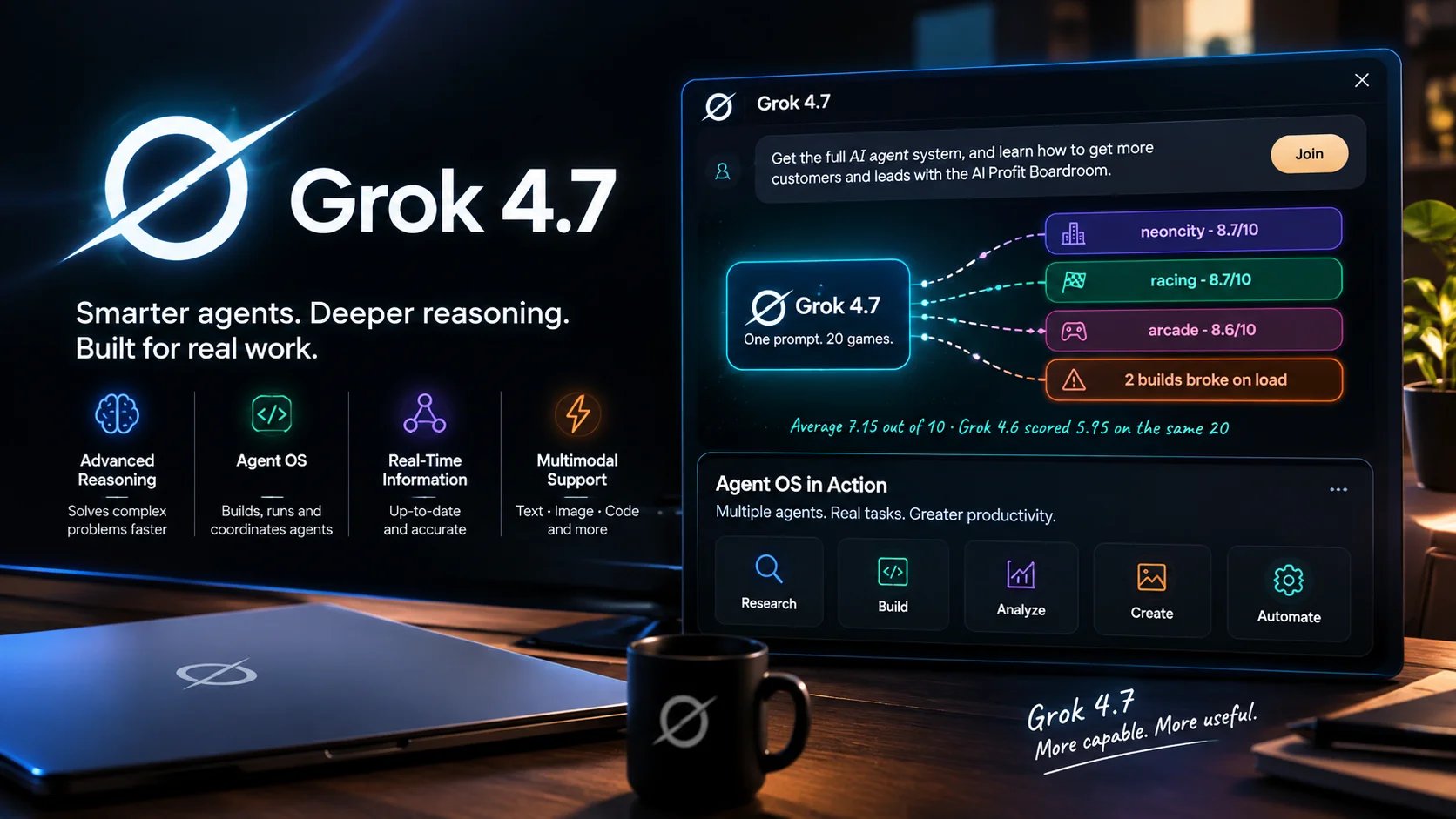
Grok 4.7 is xAI's latest large language model, built for complex coding, professional knowledge work, and reasoning tasks that can stretch over multiple hours. It accepts text and image input — meaning you can show it a picture and ask it questions about it — but everything it hands back is text. No generated images, no video, no exceptions. xAI has said as much directly: image and video generation are separate xAI products.
| Spec | Grok 4.7 |
|---|---|
| Release date | September 21, 2026 |
| Parameters | ~2.1 trillion |
| Context window | 500,000 tokens |
| Reasoning modes | Low / Medium / High (default) / xHigh |
| Knowledge cutoff | May 2026 |
| Training data notes | Includes SpaceX engineering datasets |
| Input / Output | Text + images in → text only out |
Grok 4.7 Benchmarks: Where It's Strong (and Where It Isn't)
xAI is positioning Grok 4.7 as a coding- and reasoning-first model, and the benchmark results back that framing up in some places while exposing real gaps in others:
- CursorBench 4.0: 46.3% (up from 40.4% on Grok 4.6)
- DeepSWE v1.1 (high effort): 71.0% (up from 65.2%)
- Terminal-Bench (agentic tool use): just 26% — well behind competing frontier models, and a widely noted weak spot
- LatchBio biosecurity benchmark: 62.4%, reportedly the best of its peer group
- HackerBench v0.3: blocks 96.7% of risky dual-use prompts without over-flagging legitimate security research
The takeaway from most third-party comparisons, including head-to-heads against Gemini 3.1 Pro: Grok 4.7 is a strong, cost-competitive pick for developers doing long-horizon reasoning and coding work — but it's not trying to be an all-purpose agent, and agentic/terminal tasks remain a soft spot versus rival models.
How to Access and Use Grok 4.7
Unlike some frontier model launches, Grok 4.7 rolled out with no waitlist. Here's how people are actually using it:
Through Cursor — Grok 4.7 is available as a selectable model inside Cursor's editor, making it a direct option for in-IDE coding assistance and agentic coding workflows.
Through Grok Build — xAI's own build/agent environment, aimed at longer, more autonomous coding and reasoning tasks.
Through the xAI API — for developers who want to integrate Grok 4.7 directly, with reasoning effort configurable per request (low/medium/high/xhigh).
Through model gateways — OpenRouter, Vercel AI Gateway, and Cloudflare AI Gateway all list Grok 4.7, useful if you're already routing between multiple models in one app.
Picking a Reasoning Mode
Grok 4.7's four reasoning tiers are a practical dial between speed and depth:
- Low — fastest responses, best for simple queries or high-volume, low-complexity tasks
- Medium — a balance for everyday coding and writing tasks
- High (default) — xAI's recommended setting for most professional and coding work
- xHigh — reserved for the hardest multi-hour reasoning or debugging tasks, at the highest token cost
Grok 4.7 Pricing
| Item | Price |
|---|---|
| Input (under 200K tokens) | $2 / million tokens |
| Input (over 200K tokens) | $4 / million tokens |
| Cached input | $0.50–$1.00 / million tokens |
| Output | $6–$12 / million tokens |
Pricing held steady from the previous generation — xAI's own framing was "same price, longer horizons."
So What's Grok Imagine?
The product people are actually thinking of when they ask about AI photo or video generation is Grok Imagine — a separate xAI product currently on its Image 2.0 and Video 1.5 versions. This is the tool that takes a photo and turns it into something new: text-to-image, image editing with plain-language instructions, style transfer, multi-image composition, and photo-to-video generation up to 15 seconds at 1080p.
On pure capability, Grok Imagine's Image 2.0 update (released August 2026) is genuinely competitive — ranked second globally on public arena leaderboards for both text-to-image and image editing, behind only OpenAI's image model. It added a selection-based "magic wand" editing tool, background removal, multi-reference-image generation, and one-click aspect ratio changes. Access runs through the paid SuperGrok subscription tiers rather than a standalone API.
Grok Imagine = xAI's separate image/video generator, and the product actually comparable to apps like Movcl.
Why This Distinction Isn't Just Trivia
Normally a naming mix-up between two products from the same company would be a footnote. This one isn't, because Grok Imagine has spent the better part of 2026 at the center of one of the year's largest AI trust and safety controversies.
In short: Grok Imagine shipped with a "spicy mode" that allowed adult and explicit content generation. What followed was a documented pattern of the tool being used to generate non-consensual sexualized images of real people — including, according to multiple independent analyses and news investigations, content involving minors. The scale reported by outlets like TIME, NBC News, and Reuters was substantial enough to trigger a wave of regulatory and legal action: police investigations in France and Ireland, government inquiries in the UK, attorneys general action across dozens of U.S. states, temporary platform bans in several Southeast Asian countries, and an active, expanding class-action lawsuit in the U.S. that as of mid-2026 had added new plaintiffs and defendants.
xAI's response — restricting free-tier access, then walking back editing of real people's clothing for X users, then eventually folding Imagine entirely behind a paid subscription in March 2026 — came in stages, each one after public pressure had already built. Reporting as recent as June 2026 indicated the underlying problem hadn't fully gone away even after the paywall.
The Real Lesson: It's a Design Choice, Not a Technology Problem
Every AI photo and video tool — Grok Imagine included — is built on broadly similar generative technology. What separates a tool that stays a creative, low-risk utility from one that becomes a safety and legal liability comes down to a short list of product decisions:
- Whose photos can be edited. Does the tool let you upload and manipulate photos of other people, or only your own?
- What the editing options actually allow. Are outputs constrained to defined templates and styles, or fully open-ended ("do anything to this photo")?
- Whether adult/explicit modes exist at all. A toggle for explicit content generation is a design decision made well before any misuse happens — not an unavoidable side effect of the underlying model.
- What happens after launch. Is moderation built in from day one, or added reactively once problems are already public?
Looking for an AI photo/video tool built the other way?
Movcl only edits photos you upload of yourself, run through pre-set templates — face swap, outfit change, style redraw, and short video — rather than open-ended editing of anyone's photo. Narrower by design, on purpose.
Try MovclBottom Line
Grok 4.7 is a legitimate, competitively priced reasoning and coding model, accessible with no waitlist through Cursor, Grok Build, the xAI API, or common model gateways — nothing about the model itself is controversial. The controversy belongs to a different product with a similar name, Grok Imagine, and it's a useful case study in how much an AI photo/video tool's safety comes down to deliberate design choices rather than the underlying technology. If you're picking a tool to actually edit photos of yourself — headshots, style changes, outfit swaps, or turning a photo into a short video — it's worth choosing one built around your own photos and defined templates, rather than an open-ended editor with few guardrails.
Sources: kingy.ai, llm-stats.com, androidheadlines.com, orcarouter.ai, x.ai, aitoolsreview.co.uk, suprmind.ai, imagine.art, TIME, NBC News, CNN, Euronews, Wikipedia, classaction.org. This article reflects publicly reported information as of September 2026; ongoing legal proceedings may have developed further since publication.