
Seedance 2.5 Explained: Specs, Pricing, and What It's Actually Like to Use
ByteDance's video model promises 30-second one-take scenes, 50 reference inputs, and joint audio-video generation. Here's what it actually delivers, what it costs, and why its predecessor triggered a Hollywood-wide legal fight.
Key Takeaways
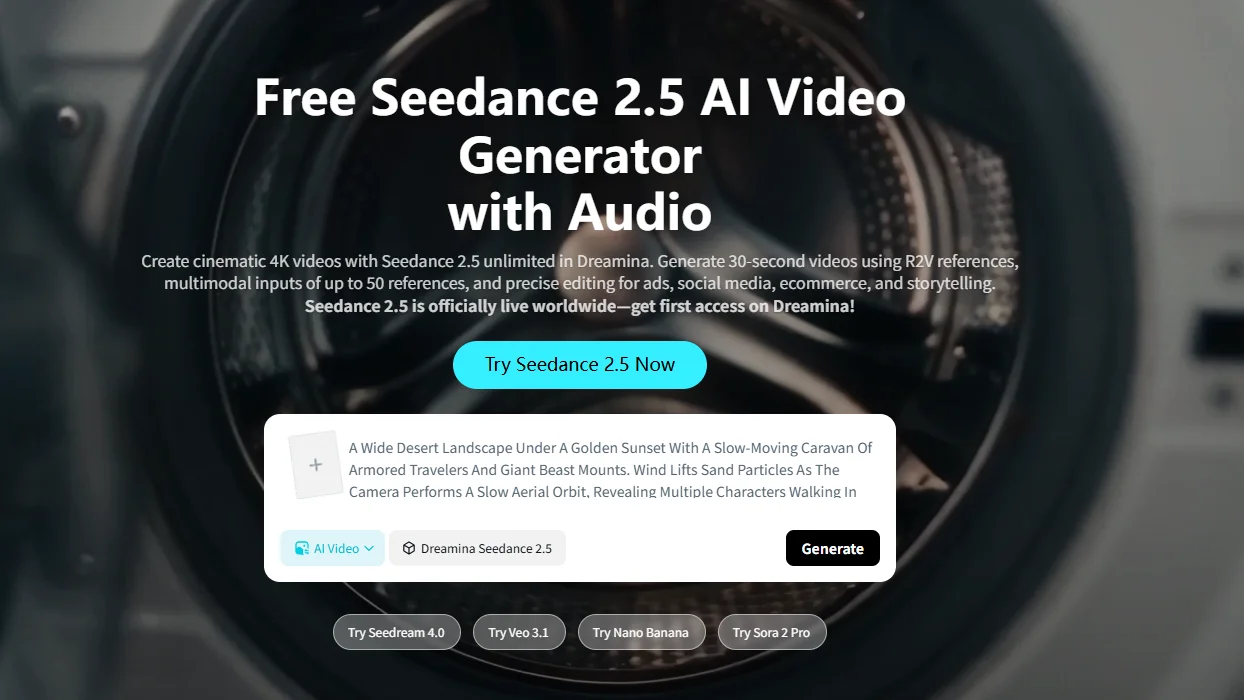
- Seedance 2.5 is ByteDance's video generation model, publicly unveiled June 23, 2026 and fully released July 31, 2026, with developer API access opening August 7.
- It generates up to 30-second one-take clips (beta modes push to 180 seconds) from as many as 50 combined reference inputs — images, video, and audio.
- Officially rated for 1080p, but multiple third-party reviews report real-world output capped around 720p — a gap worth knowing before you budget a project around it.
- Its predecessor, Seedance 2.0, triggered cease-and-desist letters from Disney, Paramount, and the MPA, plus litigation threats from Netflix, after users generated unauthorized celebrity and IP content.
- Real-world cost isn't "price per clip" — reviewers report needing dozens of generations per usable, continuity-safe shot.
On June 23, 2026, ByteDance's Seed team unveiled Seedance 2.5 at Volcano Engine's FORCE conference in Beijing, positioning it as "a next-generation audio-video joint generation model, built for 30-second storytelling with precise reference control and powerful editing capabilities." The stated goal, in ByteDance's own words, is to move creators "from merely generating a clip to completing a creative work." It fully launched July 31, with API access following on August 7.
What Seedance 2.5 Actually Does
The core pitch is length, reference flexibility, and integrated audio — three things video generation models have historically struggled to combine.
| Spec | Seedance 2.5 |
|---|---|
| Max single generation | 30 seconds (one-take), beta long-video mode up to 180 seconds |
| Reference inputs | Up to 50 combined — 30 images + 10 videos + 10 audio clips |
| Audio | Generated jointly with video in a single inference pass (dialogue, ambience, Foley, score) |
| Resolution | Officially rated up to 1080p, native 10-bit color; several third-party benchmarks report real output capped near 720p |
| Aspect ratios | 6 supported (16:9, 4:3, 1:1, 3:4, 9:16, 21:9) |
| Editing | Region- and timestamp-level edits — change one outfit, one face, or remove an object without re-rendering the full clip |
| Other tools | 3D white-model input for pre-visualization, green-screen background swap, clay-render spatial reference, camera/lighting control |
Compared to Seedance 2.0, ByteDance cites roughly a 20% improvement in prompt adherence, tighter character and lighting consistency, the new region-level editing capability, and audio moving from a separate pass to a single joint generation step. Official use cases include education (explainer and history videos), film/advertising production, industrial and robotics training footage, autonomous-driving simulation, and manufacturing training material.

How to Access and Use Seedance 2.5
BytePlus official API — direct access with official billing, priced per million tokens depending on whether the request includes video input.
Model gateways — OpenRouter, CometAPI, and similar aggregators list Seedance 2.5 alongside other video models, useful if you're already comparing outputs across providers.
Prompting tip — reviewers note that prompts written for Seedance 2.0 can produce glitchy or broken results on 2.5. The newer model reportedly responds better to longer, more restrained, rhythm-driven prompts than to quick-cut, staccam-style instructions.
Watch for inferred details — one documented quirk: the model can infer a speaker's accent from reference images, occasionally defaulting to a British-sounding voice. Reviewers found writing "American" corrects it, though "American English" can re-introduce the British inflection because of the word "English" alone.
Seedance 2.5 Pricing
| Item | Price |
|---|---|
| BytePlus official (no video input) | ~$10.70 / million tokens |
| BytePlus official (with video input) | ~$6.40 / million tokens |
| Per-second, with audio | ~$0.10/sec (480p) to ~$2.08/sec (4K) |
| Per-second, video-only | ~$0.06/sec (480p) to ~$1.24/sec (4K) |
| Official example: 5 sec, 16:9 | ~$0.51 (480p) / ~$1.16 (720p) |
One thing worth knowing before you shop around: the same underlying model can cost 10x more or less depending which third-party API platform you route through — that's channel markup, not model-level price variation.
How It Stacks Up Against Veo 3.1 and Sora 2
Independent comparison testing converges on a fairly consistent read of where each model sits:
| Seedance 2.5 | Veo 3.1 | Sora 2 Pro | |
|---|---|---|---|
| Clip length | 4–30 sec (beta to 180 sec) | 4/6/8 sec | 4/8/12/16/20 sec |
| Aspect ratios | 6 (incl. 21:9) | 2 | 2 |
| Max resolution | 720p (tested) / 1080p (official) | 4K | 1080p |
| Native audio | Yes | Yes | Yes |
| Keyframe control | Yes | Yes | No |
| Relative price | Lowest | Highest | High |
"Seedance 2.5 is the volume workhorse... Veo 3.1 is the quality ceiling... Sora 2 is the storyteller."
In short: Seedance 2.5 wins on length, format flexibility, and cost; Veo 3.1 wins on raw image quality; Sora 2 leans toward camera work and narrative flair, though it's reportedly headed toward end-of-life and isn't recommended for new projects at this point.
What Real Testing Actually Found
A few independent reviews (MindStudio, atoms.dev) offer a useful reality check against the spec sheet:
- 30-second one-take scenes genuinely help with dialogue-heavy footage, cutting reshoots. Three reference images (two character, one setting) reportedly held character consistency across a full 2-minute short.
- A recurring "warping" bug — reviewers describe visual instability in fast-motion scenes that upscaling doesn't fix, an issue that reportedly reappeared from 2.0 after being patched.
- Real cost isn't price-per-generation — one production case generated more than 16,000 video clips and 10,000 images to select just 253 usable shots for a 22-minute finished piece. As one reviewer put it: "The cost is not price per generation. It is cost per accepted, continuity-safe shot."
- Cost vs. traditional production is still dramatic: a 2-minute short (roughly 15 generations, ~450 seconds of usable footage) ran $90–$355 in one case study, against a traditional-production estimate of $20,000–$85,000.
- ByteDance itself acknowledges ongoing weak spots in complex-motion physical plausibility and multi-subject interaction stability.
The plainest summary from one reviewer: "Better tools do not automatically make better stories. The model makes it easier to produce footage. The industry still has to build the system that turns footage into work worth watching."
The Copyright Fight Seedance 2.0 Set Off
Seedance 2.5 arrives with technical improvements, but it inherits a controversy its predecessor never fully resolved. Seedance 2.0, released in February 2026, went viral in part because it could generate convincing celebrity face-swaps and recreations of copyrighted scenes — clips of Brad Pitt vs. Tom Cruise fight sequences and reimagined sitcom characters circulated widely, with per-second rendering costs reported as low as $0.14.
What followed was a rapid, high-profile legal response: Disney sent a cease-and-desist letter describing the situation as a "virtual smash-and-grab" of its IP. Paramount followed with its own letter, naming both Seedance and ByteDance's image model Seedream, spanning characters from multiple major franchises. The Motion Picture Association issued a pointed statement calling it "unauthorized use of U.S. copyrighted works on a massive scale." Netflix reportedly threatened immediate litigation, and SAG-AFTRA condemned what it called "blatant infringement" of members' voices and likenesses — with the union's president describing the technology's public accessibility as an "existential threat." ByteDance's response was to commit to adding safeguards to Seedance 2.0.
The AI Short-Drama Industry Built on Models Like This
Models in the Seedance family have also reshaped an entire content category. By one industry tracker's count, 89 of the top 100 AI-animated short dramas on Douyin in a recent month were AI-produced, and roughly 95% of short dramas released in Q1 2026 were AI-generated. The overseas AI short-drama market is estimated to have grown from about $100 million in 2025 toward $650 million in 2026, with individual platforms reporting close to $140 million in quarterly revenue each.
That growth has a human cost side, too: reporting from Digital Trends describes short-drama actors seeing their workload evaporate almost overnight after Seedance 2.0's release, and performers being asked to have their likeness, voice, and performance style "distilled" into AI systems — in some cases under pressure, with one children's program host reportedly negotiating a five-year contract with compensation and veto rights after being asked to license an AI double of herself.
The Design Question This Keeps Raising
Across both the copyright dispute and the short-drama labor story, the same underlying issue shows up: a model capable of processing any reference material — including someone else's face, voice, or copyrighted character — will eventually be used to do exactly that, regardless of the underlying use case the model was built for. The technical capability and the misuse risk aren't separable after the fact; they're a function of what the tool is allowed to reference in the first place.
That's the same reasoning behind how Movcl is built: it works from motion transfer against a single photo you upload yourself, mapped through pre-set templates, rather than open-ended generation from arbitrary reference material. It can't process someone else's face or a copyrighted character because that was never part of the input model to begin with — not a policy layered on top, but a constraint built into the underlying architecture.
Want video generation without the reference-material risk?
Movcl turns one uploaded photo of yourself into a short video using pre-set motion templates — not open-ended generation from anyone's face or footage. Built narrower, on purpose.
Try MovclBottom Line
Seedance 2.5 is a genuinely capable, low-cost video model — longer clips, more reference flexibility, and joint audio generation are real advances over 2.0, and the per-second pricing undercuts most competitors. But the spec sheet numbers (1080p, 30 seconds, 50 references) understate the practical gap between "generated footage" and "usable footage," and the model inherits a copyright and likeness controversy its predecessor never fully put to rest. If you're weighing it for a project, budget for iteration, not just generation cost — and if you just want a quick, self-contained video from your own photo, a template-based tool built around a single uploaded image will get you there with a lot less overhead.
Sources: seed.bytedance.com, evolink.ai, kie.ai, openrouter.ai, cometapi.com, cellcog.ai, trezalabs.com, wavespeed.ai, lushbinary.com, mindstudio.ai, atoms.dev, piapi.ai, Variety, CNBC, TechRadar, Digital Trends, Caixin Global. This article reflects publicly reported information as of September 2026; pricing, benchmarks, and legal proceedings may have changed since publication.